Supported Independent Living (SIL) vs SDA: Understanding the Difference Under the NDIS
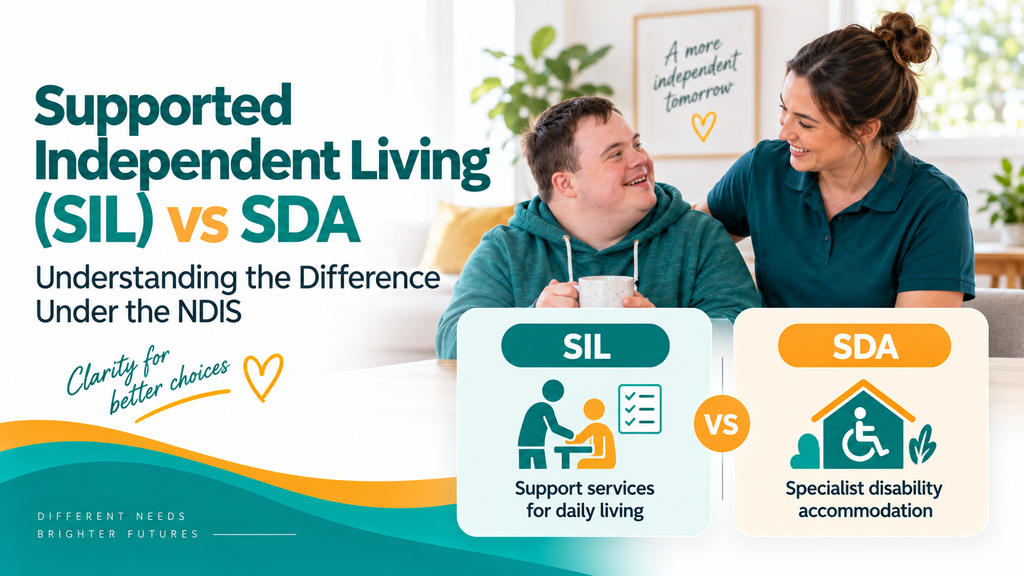
If you are exploring NDIS home and living options, you may have come across the terms Supported Independent Living (SIL) and Specialist Disability Accommodation (SDA).
The two terms are often mentioned together, which can make them easy to confuse. However, they refer to two different types of NDIS support.
The simplest explanation is:
- SIL relates to support from workers in the home.
- SDA relates to specialised housing designed for particular disability-related needs.
Some participants may have both SIL and SDA, while others may have one, neither, or another home and living arrangement entirely. Understanding the difference is particularly important for participants and families considering disability housing in Australia.
What Is Supported Independent Living?
Supported Independent Living, commonly called SIL, is funding for support workers to help or supervise a participant in their home.
The NDIS describes SIL as support-worker assistance or supervision that can be available 24 hours a day, seven days a week. Support may sometimes be shared with other residents, depending on the participant’s individual disability-related needs.
SIL is intended to support people to live as independently as possible while developing and maintaining everyday skills.
Who May Be Suited to SIL?
SIL is generally intended for people with significant day-to-day support requirements.
Current NDIS guidance indicates SIL may be suitable where a person needs support-worker availability across the day and overnight, with substantial assistance for daily activities.
However, this does not mean everyone who needs help at home will require SIL. Other home and living supports may be more appropriate depending on a participant’s circumstances, living arrangements and disability-related support needs.
What Can NDIS SIL Funding Support?
NDIS SIL funding focuses on eligible support-worker assistance rather than paying for the house itself.
SIL support can include assistance with activities such as:
- personal care;
- showering;
- dressing;
- preparing meals;
- eating;
- household activities;
- cleaning;
- supervision;
- developing everyday living skills.
The exact support arrangement depends on the individual participant’s approved plan and needs.
What SIL Does Not Pay For
One important Supported Independent Living rule to understand is that SIL funding does not pay ordinary household expenses.
Examples include:
- rent;
- groceries;
- electricity;
- ordinary household bills;
- other everyday expenses that are not NDIS supports.
This is one of the main reasons it is important to separate the concept of support from the concept of housing.
What Is Specialist Disability Accommodation?
Specialist Disability Accommodation, or SDA, refers to specially designed housing for eligible participants with extreme functional impairment or very high support needs.
SDA properties include design features intended to address particular disability-related needs and allow supports to be provided more safely or effectively.
Examples of SDA design features may include:
- wider doorways;
- wheelchair-accessible kitchens;
- ceiling hoists;
- button-operated doors;
- home automation;
- backup power;
- specialised communication technology;
- enhanced physical accessibility.
SDA can include different types of dwellings such as houses, apartments, villas, duplexes and townhouses.
The Four Main SDA Design Categories
Improved Liveability
Improved Liveability homes provide enhanced physical access and features that may support people with sensory, intellectual or cognitive impairments. Features may include visual contrast and layouts that improve visibility and accessibility.
Fully Accessible
Fully Accessible SDA provides a high level of physical accessibility. It may be suitable for people with significant physical disability, including some participants who use wheelchairs in the home.
Robust
Robust SDA uses durable design and construction to improve safety and reduce damage and maintenance needs. This type of property may suit some participants whose disability-related support needs require a more resilient physical environment.
High Physical Support
High Physical Support SDA provides significant physical accessibility features for people requiring very high levels of support. Features may include ceiling hoists, home automation, communication technology and backup power. The category included in a participant’s plan, if SDA is funded, depends on the person’s individual needs and the NDIA’s decision.
SIL vs SDA: What Is the Main Difference?
A simple way to remember the distinction is:
SIL = support
SIL relates to the eligible support workers who assist a participant in their home.
SDA = accommodation
SDA relates to the physical dwelling and its specialised design.
How they can work together
For example, a participant may live in a High Physical Support SDA property because they require significant accessibility features and also have SIL funding for support workers who assist with personal care, meals and everyday routines. In that situation, the SDA funding relates to the property, while SIL funding relates to eligible support-worker assistance.
Can You Have SIL Without SDA?
Yes. A participant does not need to live in an SDA property simply because they have SIL funding.
A person may live in another suitable home and receive SIL if SIL is included in their NDIS plan and the living arrangement meets their circumstances and support needs.
SDA is specifically intended for eligible people with extreme functional impairment or very high support needs. It is not the standard housing option for every participant receiving support at home.
Can You Have SDA Without SIL?
Potentially, yes. SDA and SIL are assessed as different supports.
A participant living in SDA may receive a different form of in-home support rather than SIL, depending on their approved plan.
This is why families should avoid assuming that approval for one automatically guarantees approval for the other.
Does SDA Mean Free Housing?
No. SDA funding should not be understood as the NDIS paying every housing cost for the participant.
Participants living in SDA generally pay a reasonable rent contribution as well as ordinary day-to-day living costs such as electricity. The housing agreement should make those costs and responsibilities clear.
Important 2026 Supported Independent Living Rules
There have been significant changes to SIL provider requirements in 2026.
From 1 July 2026, providers delivering SIL are required to be registered with the NDIS Quality and Safeguards Commission. Transitional arrangements apply for providers moving into the new mandatory registration requirements.
This is an important change for participants who currently receive SIL or are considering a new SIL provider. If you are speaking with a SIL provider during the transition period, ask whether they are appropriately registered or have taken the required steps to register.
New SIL Practice Standards in 2026
New NDIS Practice Standards specifically for Supported Independent Living also apply from 1 July 2026.
The standards strengthen expectations around supported decision-making, safeguarding, practice governance and clear agreements about tenancy, housing and support arrangements.
The aim is to strengthen quality, safety and accountability while protecting participant rights, dignity and freedoms in the home.
Why Housing and Support Agreements Should Be Clear
Participants should understand who provides their housing and who provides their support.
The SIL Practice Standards emphasise clear and accessible arrangements that distinguish between tenancy or housing agreements and SIL support agreements.
This distinction is important because your rights and responsibilities as a tenant or resident may be different from the arrangements you have with the organisation providing your disability supports.
Before signing anything, make sure you understand:
- who your landlord or housing provider is;
- who provides your SIL supports;
- what each agreement covers;
- what fees or charges apply;
- how support arrangements can be changed;
- what happens if you want to change providers;
- how complaints and concerns are handled.
Questions to Ask a SIL Provider
Choosing a provider can have a significant effect on everyday life.
Consider asking:
- Are you appropriately registered to provide SIL under the current requirements?
- How will my daily routines and preferences be respected?
- How are support workers selected or matched?
- Will workers be shared with other residents?
- What overnight support is available?
- How do you support participant choice and decision-making?
- How are emergencies and incidents managed?
- How do you support independence rather than doing everything for participants?
- What happens if my support needs change?
- How is my SIL service agreement separated from my housing arrangement?
- How can I make a complaint or provide feedback?
The answers should be clear and understandable.
Questions to Ask When Considering SDA
The physical home matters just as much as the support arrangement.
Consider:
- Is the property enrolled as SDA?
- Does it match the SDA category in my plan?
- Is the location suitable for me?
- Can I stay connected with family and friends?
- Is public transport accessible?
- Are shops and health services nearby?
- How many other people live in the home?
- What areas are private and what areas are shared?
- What rent contribution will I pay?
- What other bills will I be responsible for?
- Does the design meet my accessibility needs?
SDA homes must be enrolled, and SDA providers must be appropriately registered.
Choosing Disability Housing in Adelaide
Location can make a major difference to a person’s independence, relationships and connection to community.
For participants exploring NDIS home and living options in Adelaide, it may be useful to consider how different areas fit with work, healthcare, family, community activities and transport.
This might include areas such as:
- Salisbury, Elizabeth and Mawson Lakes in Northern Adelaide;
- Noarlunga, Marion and Morphett Vale in Southern Adelaide;
- Woodville, Port Adelaide and Hindmarsh in Central West Adelaide;
- Modbury, Golden Grove and Tea Tree Gully in North East Adelaide.
Choosing the right location
There is no single location that will be right for everyone. The most suitable option depends on the participant’s own preferences, relationships, disability-related needs and approved supports.
Not Everyone Needs SIL or SDA
SIL and SDA are important parts of disability housing in Australia, but they are not appropriate for every NDIS participant.
Many people with disability live in a private rental, their own home, a family home or social housing while receiving other NDIS-funded supports.
The important question is which combination of housing and disability supports best reflects the participant’s individual needs, preferences and approved plan.
Talk to MIBALA CARE About Disability Support in Adelaide
If you are exploring your NDIS home and living options, understanding the difference between SIL and SDA is only one part of the process.
You may also need to think about the practical support you receive with everyday life, personal care, transport, skill development and participation in the community.
MIBALA CARE currently provides In-Home Supports, Personal Care Support, Assistance in Daily Life, Community Participation, Mentoring and Personal Skills Development, and Transport Support.
Our team supports participants across priority areas of Northern Adelaide, Southern Adelaide, Central West Adelaide and North East Adelaide, including Salisbury, Elizabeth, Mawson Lakes, Marion, Morphett Vale, Woodville, Port Adelaide, Modbury, Golden Grove and surrounding suburbs.
Get in touch with the MIBALA CARE team today to discuss your individual needs, your approved NDIS supports and our current service availability.
If you are specifically looking for SIL or SDA, always confirm that the organisation you are considering is appropriately registered and currently authorised to deliver that particular service.
Important information: This article provides general information only. SIL, SDA and other home and living supports depend on each participant’s circumstances, approved NDIS plan and applicable funding criteria. Inclusion of any support is not guaranteed.
Need NDIS Support in Adelaide?
Mibala Care Pty Ltd
📞 +61 485 608 168
📧 info@mibalacare.com.au
🌐 mibalacare.com.au
📍 Level 7/38 Currie Street, Adelaide SA 5000