NDIS Plan Review Tips: How to Prepare for Your Next Plan Reassessment
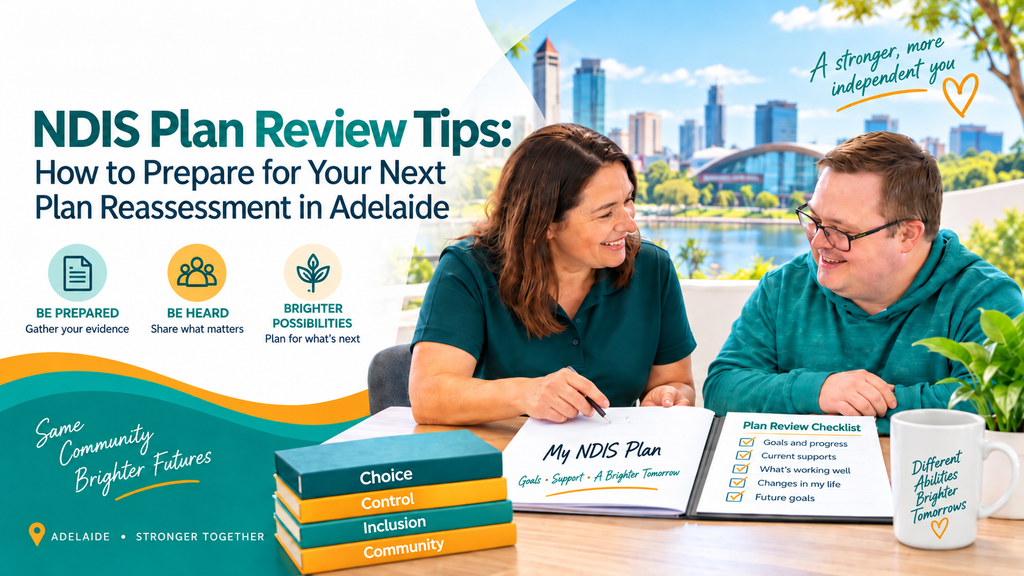
Preparing for changes to your NDIS plan can sometimes feel like a lot to manage. You may be thinking about your goals, your current supports, changes in your daily life, reports from professionals and whether your existing funding is meeting your disability-related needs.
The good news is that you do not need to wait until the last moment to start preparing. Taking time to review what is working, what has changed and what you may need in the future can help you communicate your circumstances more clearly.
For NDIS participants and families across Adelaide, including Salisbury, Elizabeth, Mawson Lakes, Marion, Morphett Vale, Port Adelaide, Woodville, Modbury and surrounding suburbs, this guide explains practical NDIS plan review tips based on the current 2026 process.
Is It Still Called an NDIS Plan Review?
You may still hear people use the term NDIS plan review, and it remains a common phrase when participants search for information online.
However, the NDIS now generally refers to the process of creating a new plan following significant changes as a plan reassessment. Smaller changes may instead be made through a plan variation.
A plan reassessment may be relevant when your situation or disability-related support needs have changed significantly and your current plan may no longer meet those needs. Changes could involve your daily activities, living arrangements, education, employment or support from other people.
When Should You Start Preparing?
For a scheduled reassessment, your my NDIS contact may contact you for a check-in around two to three months before your plan’s reassessment date. This gives you an opportunity to discuss how your current plan is going and whether your circumstances have changed.
You do not need to wait for that conversation before organising your information.
Starting early can give you more time to:
- review your existing NDIS plan;
- think about your current goals;
- gather relevant reports and evidence;
- review how your existing supports are working;
- identify any significant changes in your circumstances;
- prepare questions you want to ask.
1. Review Your Current NDIS Plan
A useful first step is to sit down with your current plan and look at the supports that have been available to you.
Do not focus only on how much funding remains. Think about what the supports have meant in your everyday life.
Ask yourself questions such as:
- Which supports have been most useful?
- Which supports have helped me become more independent?
- Are there important daily activities where I still require assistance?
- Have I been able to participate in my community in the way I hoped?
- Have some supports been difficult to access?
- Have my routines or support needs changed?
- Are there supports I did not use? If so, why?
- Have my living, work, study or family circumstances changed?
The aim is not to create the “perfect” answer. It is to give an accurate picture of your experience.
2. Think About Your Current and Future Goals
Your goals should reflect what matters to you.
Depending on your circumstances, goals may relate to independence, daily living, relationships, employment, education, mobility, communication or social and community participation.
The NDIS recommends thinking about your goals, preferences, community connections and significant life changes you may expect over the coming years when preparing for a reassessment.
Examples of areas you might think about include:
- learning to prepare more meals independently;
- becoming more confident completing household tasks;
- increasing participation in social or recreational activities;
- building confidence when accessing the community;
- developing personal care routines;
- learning new daily living skills;
- starting work or education;
- changing where or how you live.
Remember that having a goal does not automatically mean a particular support will be funded. NDIS supports still need to meet the applicable funding criteria.
3. Gather Relevant Evidence
Evidence can help the NDIA understand your disability-related support needs, how your circumstances have changed and how existing supports are working.
Depending on your situation, useful information may come from treating healthcare professionals, therapists or support workers. Official NDIS guidance notes that assessments and reports may show how supports are helping you work towards your goals and may include recommendations about future support needs.
Relevant evidence might include:
- occupational therapy reports;
- physiotherapy reports;
- speech pathology assessments;
- information from treating health professionals;
- functional assessments;
- support-worker progress information;
- reports describing changes in daily functioning;
- information about changes to informal supports;
- evidence relating to changes in living arrangements;
- information showing barriers to community participation.
The evidence should be relevant to your individual circumstances. A large volume of paperwork is not necessarily better than clear, current information that explains your actual needs.
4. Know the New 2026 Rules for Participant-Requested Reassessments
There was an important NDIS change on 27 August 2026.
Under the current rules, only the participant, their nominee or their child representative can request a plan reassessment. A provider cannot simply make the reassessment request on the participant’s behalf.
If you are requesting a reassessment because of a significant and ongoing change outside your normal check-in process, you need to use the appropriate plan reassessment request form and provide supporting evidence.
Current NDIS guidance says evidence for this type of request generally needs to be recent and relevant to the change being requested.
If you are unsure whether your circumstances require a plan variation or a full reassessment, speak with your my NDIS contact.
5. Keep Track of What Your Current Supports Are Achieving
Try to think beyond the name of a support.
For example, rather than only saying, “I receive community participation support,” consider what that assistance allows you to do.
It might help you:
- attend a local community activity;
- practise travelling outside the home;
- maintain social connections;
- attend appointments;
- develop confidence communicating with other people;
- participate in recreational activities;
- build everyday skills.
Why specific examples matter:
Similarly, assistance with daily life may support you to maintain routines, prepare meals, complete household activities or develop greater independence. Specific examples can make it easier to explain how your support needs affect everyday life.
6. Use a Plan Management Checklist
If some or all of your eligible support budgets are plan-managed, it can be useful to review your financial information before your next plan conversation.
A registered plan manager may manage payments, keep financial records, monitor budgets, check and submit claims and provide regular statements about your NDIS funding. Participants remain responsible for understanding their plan and ensuring their funding is used appropriately.
Simple plan management checklist
- How much of each relevant budget has been used?
- Are there budgets that have been used faster than expected?
- Are there budgets that have barely been used?
- If funding was not used, what prevented you from accessing the support?
- Are your current service agreements still appropriate?
- Are your invoices and service records organised?
- Are you receiving regular statements from your plan manager?
- Do you understand which supports are plan-managed?
- Have there been unexpected changes in support needs?
Your plan manager can help you understand your spending, but they do not decide what funding will be included in your next NDIS plan.
7. Describe What an Ordinary Day Looks Like
NDIS terminology can sometimes make a person’s life sound more complicated than it needs to.
One useful preparation technique is to think through a normal day from morning to evening.
Consider what happens when you:
- get out of bed;
- shower and get dressed;
- prepare breakfast;
- complete household tasks;
- leave the house;
- use transport;
- go shopping;
- attend appointments;
- communicate with other people;
- participate in your community;
- prepare meals;
- complete your evening routine.
Think about where you need physical assistance, prompting, supervision or another type of disability-related support. This can help you identify needs that might otherwise be forgotten during a meeting.
8. Consider Changes to Informal Supports
Support from family members, friends and other people in your life can change over time.
A family member may return to work, move away, experience other responsibilities or no longer be able to provide the same level of assistance.
If there has been a significant change to the informal support available to you, explain what has changed and how that affects your day-to-day support needs.
Do not assume that the person you are speaking with already knows the details.
9. Write Down Your Questions Before the Conversation
It is easy to forget something important during a meeting or phone call.
Keep a simple written list.
You might want to ask:
- What happens next?
- Do you need any additional evidence from me?
- Is the change I am requesting considered a variation or reassessment?
- How will I receive information about the outcome?
- What should I do if my circumstances change again?
- How can I understand the funding in my new plan?
Having questions prepared can make the conversation easier and help you feel more organised.
What Happens After a Plan Reassessment?
The NDIA reviews the information and evidence provided and considers what NDIS supports meet the applicable requirements.
Current NDIS guidance explains that the outcome can include a variation to the existing plan, creation of a new plan, or no change to the plan.
No disability service provider can guarantee that a particular request, level of funding or support will be approved. Funding decisions are made by the NDIA based on the participant’s individual circumstances and applicable NDIS rules.
Choosing an NDIS Provider in Adelaide After Your Plan Changes
Once you receive your plan, the next step is understanding how your approved supports can work in your everyday life.
A good NDIS provider should listen to your preferences, respect your choices and discuss how services can be delivered in a way that supports your individual goals.
MIBALA CARE currently provides services including In-Home Supports, Community Participation, Personal Care Support, Mentoring and Personal Skills Development, Assistance in Daily Life and Transport Support.
We support participants across priority Adelaide service areas including:
- Northern Adelaide: Salisbury, Elizabeth, Mawson Lakes and surrounding suburbs;
- Southern Adelaide: Noarlunga, Marion, Morphett Vale and surrounding suburbs;
- Central West Adelaide: Woodville, Port Adelaide, Hindmarsh and nearby areas;
- North East Adelaide: Modbury, Golden Grove, Tea Tree Gully and surrounding suburbs.
Talk to MIBALA CARE About Your NDIS Supports in Adelaide
If you are preparing for your next NDIS plan reassessment, or you have recently received a new plan and are looking for reliable disability support in Adelaide, get in touch with the MIBALA CARE team.
We can discuss your individual support needs, your preferences and the services we currently provide, and explain whether our available supports may align with your approved NDIS plan.
Whether you are looking for assistance at home, personal care, help with daily activities, transport, mentoring or support to participate in your community, our approach centres on dignity, independence, choice and respectful support.
Contact MIBALA CARE today to discuss current service availability across Northern Adelaide, Southern Adelaide, Central West Adelaide and North East Adelaide.
Important information: This article provides general information only and is not individual NDIS planning, legal or financial advice. NDIS rules and individual plans can change. For information about your individual plan, contact the NDIA or your my NDIS contact.
Need NDIS Support in Adelaide?
Mibala Care Pty Ltd
📞 +61 485 608 168
📧 info@mibalacare.com.au
🌐 mibalacare.com.au
📍 Level 7/38 Currie Street, Adelaide SA 5000